Claude Now Writes 80% of Anthropic's Code
June 6, 2026
On June 4, Anthropic published a report called "When AI Builds Itself." The headline number landed hard.
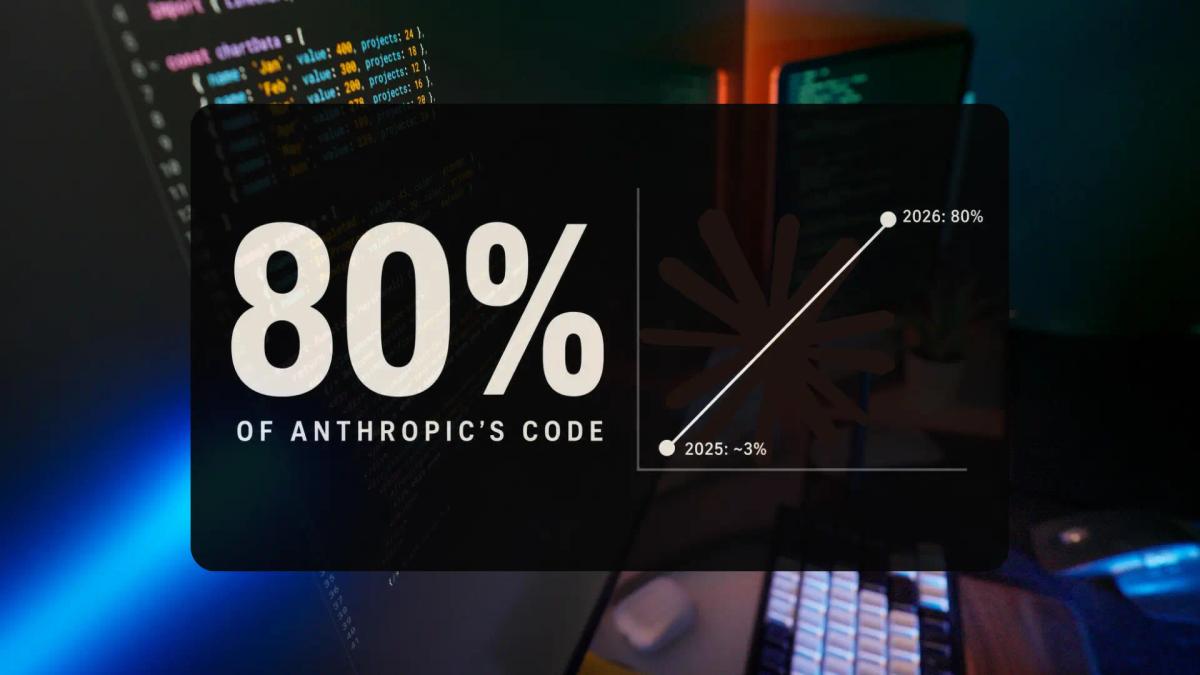
As of May 2026, more than 80% of the code merged into Anthropic's codebase was authored by Claude — up from low single digits before Claude Code launched in research preview in February 2025.
The average Anthropic engineer in Q2 2026 is merging eight times as much code per day as in 2024.
That's not a rounding error. That's a different job.
What the Numbers Actually Say
Before taking the 80% figure at face value, it's worth reading what Anthropic says about it in the same breath.
The report flatly states that lines of code are an imperfect measure — it counts quantity, not quality, so the 8× figure "is almost certainly an overstatement of the true productivity gain." A separate internal poll put the median researcher's self-estimated uplift at roughly 4×.
So the real productivity gain is probably somewhere between 4x and 8x. Still a fundamental shift, just not quite as clean as the headline implies.
Leadership estimates the total share — including scripts and experimental code — at more than 90%. One employee is quoted: "it's now been ~5 months since I last wrote any code myself."
That quote is doing a lot of work.
What Claude Is Actually Doing
This isn't autocomplete at scale. The workflow has changed structurally.
The AI is no longer suggesting snippets that a human copies and pastes. It now runs code, proposes and executes experiments, and applies the results directly to the codebase. Engineers are directing and reviewing rather than typing.
The task completion numbers back this up. Claude's task success rate on hard, underspecified problems — the kind where no clear spec exists upfront — hit 76% in May 2026, up 50 percentage points in six months.
That last part is the significant one. Ambiguous problems are the hard part of software engineering. Getting from 26% to 76% success on those in six months is not incremental progress.
The internal Mythos Preview model achieved a 52x speedup on an ML optimization benchmark where the previous generation reached 3x — a jump that happens when a model transitions from being a capable assistant to something closer to an autonomous engineer.
Where Humans Still Matter
Anthropic is direct about this in the report, and it's worth quoting.
"The comparative advantage of humans as of right now is still in seeing the bigger picture and thinking beyond the confines of the immediate task."
Claude can execute. It's getting better at ambiguous tasks. But goal-setting, architectural judgment, and deciding what to build next — those are still human inputs. For now.
The automated layer also caught approximately one-third of the production bugs responsible for historical outages on claude.ai — so the quality argument isn't just speed, it's reliability too.
The Other Half of the Report
The productivity data is the hook. The actual argument Anthropic is making goes further.
Anthropic is urging frontier AI labs to agree on a coordinated way to slow or pause development if advanced systems begin improving themselves faster than society can manage. The company said unilateral action would not be enough — any pause would need verification, shared rules, and participation from major AI labs.
This is not a unilateral shutdown pledge. It is a governance pitch timed one week after Anthropic confidentially filed for IPO.
The critics noticed. David Sacks, a venture capital investor and informal adviser to President Trump, accused Anthropic's leaders of running a "regulatory capture agenda," warning it could lead to efforts to ban open-source models. Others called it a marketing move. Both things can be true.
What's not in dispute: the 80% figure is real internal data from a company that is actively building with these tools and publishing its numbers. That's more than most are sharing.
What This Means for Developers
If you're building software and you're not yet running Claude Code or an equivalent agentic coding tool in a serious way, Anthropic just showed you what the gap looks like.
Claude Code awareness among developers jumped from 31% in mid-2025 to 57% by January 2026, with workplace adoption growing roughly 6x in the same period. SemiAnalysis estimates it now accounts for roughly 4% of all public GitHub commits, with projections pointing toward 20% by year-end.
The teams moving fastest aren't using AI as an assistant. They're using it as an executor and reviewing the output. That's a workflow shift, not a tool upgrade.
The job isn't disappearing. Software developer roles are still projected to grow 15% this decade — the field is changing shape rather than vanishing for prepared workers. But "prepared" now means something different than it did 18 months ago.
Sources: Anthropic Institute — "When AI Builds Itself", VentureBeat, The Decoder