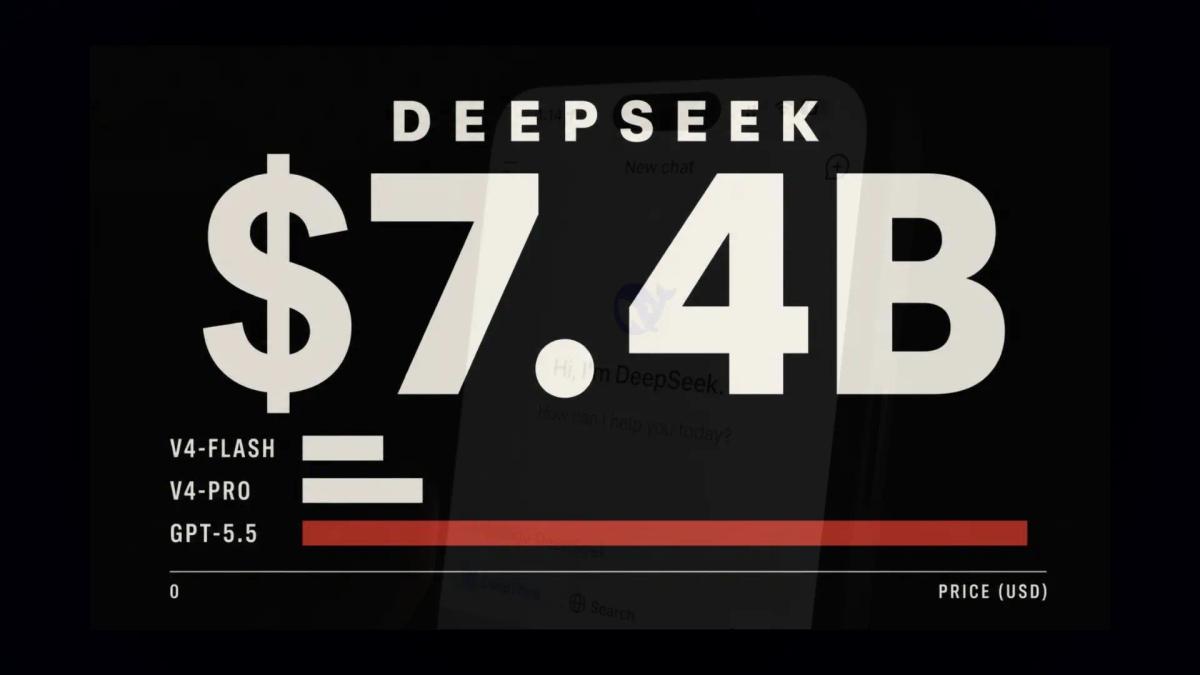
DeepSeek Is Raising $7.4B. Here's What Changes
June 5, 2026
DeepSeek built its reputation on one thing: doing more with less. No VC money, no infrastructure arms race, just a quant hedge fund bankrolling a lean AI lab that kept beating frontier models on a fraction of the budget.
That era just ended.
DeepSeek is set to raise about $7.4 billion in its first-ever outside funding round — a reversal of its years-long strategy of not seeking external capital, a policy enabled by founder Liang Wenfeng's quant hedge fund High-Flyer.
Who's Investing and How Much
Liang Wenfeng is expected to contribute $3 billion of his own capital. Tencent is planning $1.5 billion and CATL is set to commit $740 million — making them the largest external investors in the round. China's National AI Industry Investment Fund, NetEase, and JD.com are also in final talks to participate. Fewer than 10 investors are expected total.
The round could value DeepSeek at between $52 billion and $59 billion post-investment. For context, OpenAI raised $122 billion in March, while Anthropic raised $65 billion last month. DeepSeek is still a fraction of their scale — but it wasn't even in this conversation a year ago.
Why They Need the Money Now
The planned round marks a shift driven by rising demand for advanced AI agents and computing power — pushing the company toward a larger capital base.
The models that made DeepSeek famous — R1 and V3 — were built on efficiency. But agentic workloads are a different beast. Longer context, multi-step reasoning, persistent sessions — these are compute-hungry in ways that a lean research lab with borrowed GPUs can't sustain at scale.
With Tencent's cloud infrastructure and CATL's energy resources, DeepSeek can build dedicated compute capacity. CATL's participation signals AI-optimized data centers with integrated power — not just renting GPUs.
This isn't expansion for its own sake. It's DeepSeek building the infrastructure to compete in the agentic era, not just the benchmark era.
What This Means for Developers
Here's the honest answer: probably not much in the short term.
The API pricing is still the most competitive in the market. V4-Flash is $0.14 per million input tokens. GPT-5.5 costs $5.00. Claude Opus 4.7 costs the same. For teams running output-heavy agent loops, that's not a marginal difference — it's a different product economics conversation.
DeepSeek made the 75% discount on V4-Pro permanent after May 31. The message was blunt: premium AI model access is being dragged into a much tougher cost-performance contest.
That doesn't change because Tencent wrote a cheque.
What does change — gradually — is the strategic incentives behind the lab. A bootstrapped DeepSeek had one goal: prove efficiency. A VC-backed DeepSeek with Tencent as a major investor has a different set of pressures. Tencent has its own AI model (Hunyuan) that's been trailing the field. A closer relationship with DeepSeek could help Tencent keep pace with rival Alibaba, which has prioritised its in-house Qwen model. DeepSeek's independence, at least in the long run, is now more complicated.
The Open Model Question
This is the thing worth watching most closely. DeepSeek's open-weight releases — V3, R1, now V4 under MIT licence — are what made it genuinely useful for developers who want to self-host, fine-tune, or avoid API dependency entirely.
Outside investors don't automatically end that. But they do introduce pressure to monetise. The open releases were a competitive tactic for a scrappy lab trying to build credibility and developer adoption. For a $59 billion company backed by Tencent and state-linked funds, the calculus is different.
There's no sign of a policy change yet. But if you've been building on DeepSeek because of the open weights, it's worth paying attention to what happens to that programme over the next 12 months.
The Deadline You Shouldn't Miss
Separate from the funding news — the legacy deepseek-chat and deepseek-reasoner API aliases are being retired July 24, 2026. After that, API calls using those names return errors. New integrations should use deepseek-v4-flash and deepseek-v4-pro explicitly.
If you're in production with either of those aliases, that's a one-line fix that needs to happen before July 24.
DeepSeek changed the AI pricing conversation when it launched R1 with basically no funding. Now it's taking $7.4 billion. The cheap API isn't going anywhere today — but the lab that built it is becoming something different.
Sources: Reuters via Yahoo Finance, TechNode, CloudZero