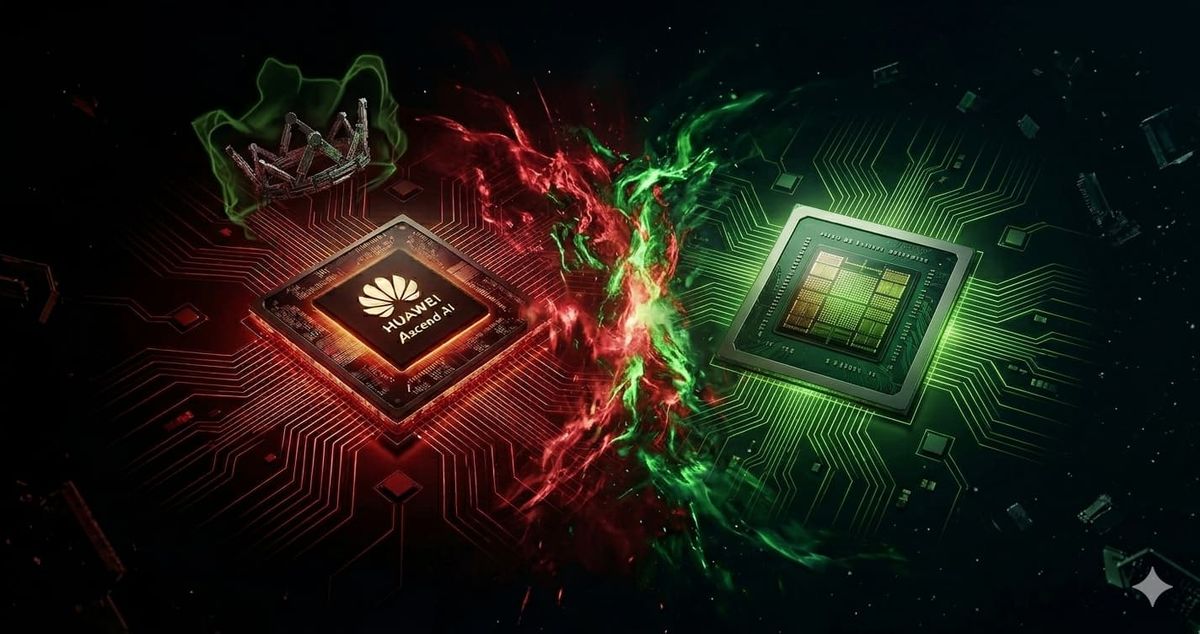
Huawei Is Coming for Nvidia's AI Chip Crown
May 21, 2026
Huawei is having a moment. While most of the West still associates the company with banned 5G equipment and Google-less phones, something much bigger is happening on the AI hardware front — and developers building on AI infrastructure should pay attention.
The Ascend 950PR: Huawei's H20 Killer
In March 2026, Huawei launched the Ascend 950PR — a chip that, on paper, directly challenges Nvidia's China-market GPU.
The Ascend 950PR delivers 1.56 petaflops at FP4 precision and claims 2.8x the FP4 performance of Nvidia's H20. That's not a rounding error. That's a significant gap.
The chip packs 112GB of proprietary HiBL 1.0 memory with 1.4 TB/s bandwidth and ships as the compute core of the new Atlas 350 accelerator card. ByteDance has already committed $5.6 billion in orders, which tells you this isn't vaporware.
The catch: at 600W TDP, the 950PR draws roughly 200W more than Nvidia's H20, which matters if you're running power-constrained data centers. Huawei argues the inference throughput advantage more than compensates — but that's a workload-by-workload calculation.
The Cluster Play
Huawei's real bet isn't individual chip performance. It's at the cluster level.
The Atlas 950 SuperPoD links up to 8,192 Ascend chips into a single logical AI system, targeting 8 exaflops of FP8 performance backed by 1,152 TB of memory and 16.3 petabytes per second of interconnect bandwidth.
The roadmap doesn't stop there — Huawei's Ascend 960, expected in 2027, is projected to double the 950's capabilities and tie together as many as 15,488 units in a single system.
This is Huawei leveraging its telecom heritage. They know how to build networks. They're applying that to AI infrastructure.
Why This Is Happening Now
US export controls cut Chinese AI labs off from Nvidia's most powerful GPUs. That created a vacuum — and Huawei is filling it fast.
A Financial Times report found Huawei is on track to capture the largest share of China's AI chip market in 2026, driven by Chinese firms pivoting to domestic alternatives as Nvidia's H20 shipments stall in regulatory limbo.
Huawei's Ascend chips run on CANN, its open-sourced compute architecture that supports PyTorch and Triton — so the migration story for AI developers isn't as painful as it used to be.
Outside the Data Center
On the consumer side, Huawei is also moving fast. Counterpoint data from China's May Day Sales 2026 showed Huawei leading the smartphone market even as the overall market fell 16% year-on-year — driven by the Enjoy 90 Pro Max's battery life and value positioning.
At its "Now Is Your Spark" global launch event in Bangkok in May, Huawei debuted the MatePad Pro Max, Watch Fit 5 Series, and the GT Runner 2 Racing Legend Edition. The hardware lineup is broad and aggressive.
What Developers Should Know
If you're building on AI infrastructure, Huawei's Ascend ecosystem is no longer a niche China-only story. With the Atlas 950 SuperPoD now unveiled globally at MWC 2026, Huawei is explicitly targeting the international AI data center market — not just filling a domestic gap.
It's not Nvidia. It's not there yet on software ecosystem maturity. But it's real competition, and the gap is closing faster than most expected.
Sources: Tom's Hardware, TechRadar, Huawei Central, IEEE Spectrum