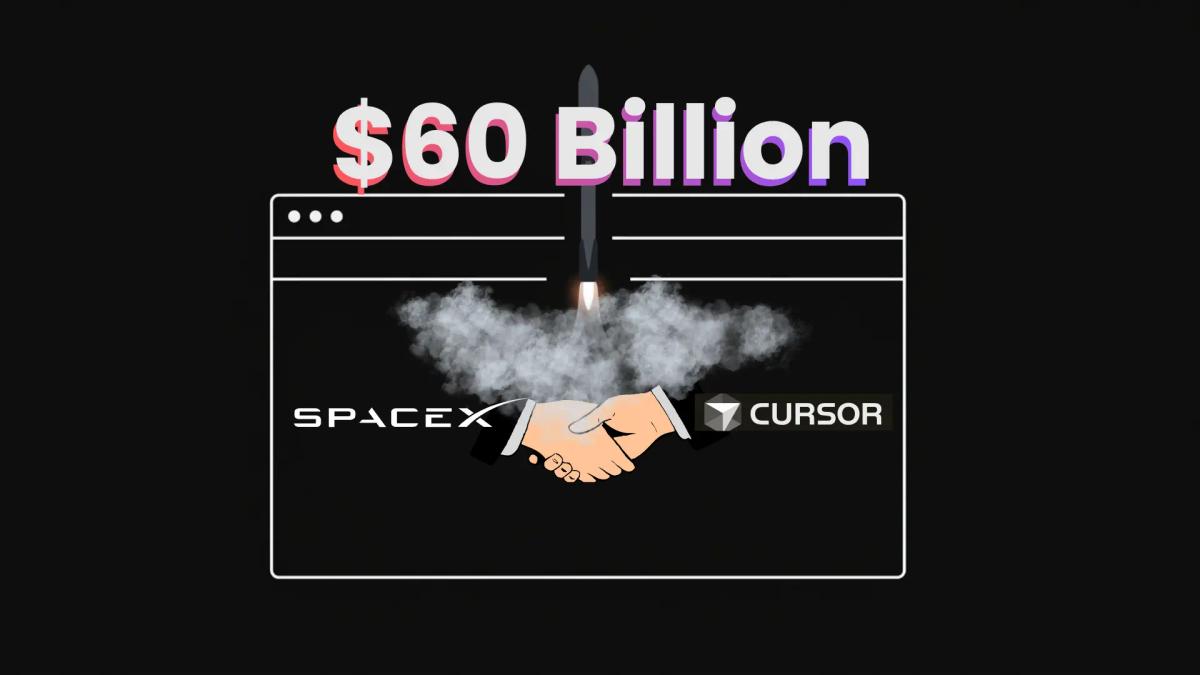
SpaceX Is Buying Cursor for $60 Billion
May 30, 2026
If you use Cursor, Elon Musk is about to own your code editor.
On April 22, 2026, SpaceX announced it had secured the right to acquire Cursor — the AI-powered IDE built by Anysphere — for $60 billion later this year. The deal was buried inside a post on X, dropped just before the New York Times broke the story. Subtle, as always.
The Deal Structure
It's structured as an option, not a closed acquisition — yet.
SpaceX has obtained the right to buy Cursor for $60 billion later this year. If it doesn't proceed with the full acquisition, it pays Cursor $10 billion for the work they've done together.
That $10 billion "walk-away" number is not a small consolation prize — it's larger than most Series B rounds ever raised. It signals just how seriously SpaceX wants this done.
SpaceX committed the $10 billion collaboration payment immediately as part of the agreement. The full $60 billion acquisition still requires regulatory review before it can close.
What SpaceX Gets
Cursor's valuation has gone from $2.5 billion in early 2025 to $60 billion in April 2026 — one of the fastest startup valuation runs in history. SpaceX isn't buying it because it's cheap. It's buying it because of what Cursor has built.
Cursor launched its AI coding assistant in 2023, accumulated more than one million paying customers, hit $500 million in annualised revenue by May 2025, and doubled that to $1 billion by October. That trajectory is why the price tag is what it is.
SpaceX's own post made the strategic logic explicit: "The combination of Cursor's leading product and distribution to expert software engineers with SpaceX's million H100 equivalent Colossus training supercomputer will allow us to build the world's most useful models."
Translation: Cursor brings the users and the product. Colossus brings the compute. xAI's Grok provides the model. The three together give SpaceX a full-stack AI coding platform — distribution, infrastructure, and model — in one move.
Why This Is an xAI Play, Not a SpaceX One
Cursor fits into the short-term goal of bolstering xAI's ability to develop coding tools, given that xAI has fallen well behind Claude Code and Codex in the coding assistant market.
Claude Code helped push Anthropic's annualised revenue past $30 billion as of April 2026. OpenAI's Codex crossed four million active users on the same day SpaceX announced the Cursor deal. xAI had neither a competitive coding product nor meaningful distribution among working developers. Cursor solves both problems immediately.
Cursor CEO Michael Truell responded on X: "Excited to partner with the SpaceX team to scale up Composer" — the name of Cursor's own underlying coding model. The framing matters. Cursor's team sees this as a scale play for their model, not just a product acquisition.
Microsoft Passed on This
Microsoft had explored acquiring Cursor but ultimately chose not to move forward. That's a striking decision given what Cursor has become — and what Microsoft already has in GitHub Copilot.
The read: Microsoft bet on its Copilot ecosystem over acquiring the competitor. SpaceX bet $60 billion that was the wrong call.
What Happens to Cursor Users
The immediate answer is: nothing changes yet. The acquisition hasn't closed. Cursor is still operating independently and the product roadmap is publicly unchanged.
But the longer-term questions are real. When a tool used by over a million developers gets absorbed into Elon Musk's empire — alongside X, xAI, SpaceX, and Colossus — the data, pricing, and model strategy all become subject to new ownership priorities.
The long-term vision Musk outlined to employees when the SpaceX/xAI merger went through was explicit: "In the long term, space-based AI is obviously the only way to scale." How Cursor fits into that orbital roadmap remains to be seen.
What's certain: if the acquisition closes, every codebase Cursor users have opened, every prompt they've run, and every completion they've accepted is now part of SpaceX's AI training infrastructure story. That's worth thinking about before the deal finalises.
The Bigger Picture
This is the latest in a series of moves that make SpaceX look less like a rocket company and more like an AI conglomerate with a launch business attached.
Musk merged SpaceX with xAI in February 2026 in a deal valued at $1.25 trillion. The combined company filed its IPO prospectus on May 20, targeting a Nasdaq listing under the ticker SPCX as early as June 12 at a valuation of $1.75 trillion. If it closes at that number, it's the largest IPO in history.
OpenAI is also preparing to file confidentially for an IPO in the coming weeks. Anthropic is reportedly considering a public debut as early as October 2026.
The AI coding wars are heading toward the public markets. Cursor is the most expensive single move in that race so far.
Sources: CNBC, The Next Web, Yahoo Finance, AI Business, Wikipedia — Cursor