Valve Steam Machine 2026 — Specs, Price, Release Date and Everything You Need to Know
May 11, 2026
Valve is taking another shot at the living room. More than a decade after the original Steam Machines quietly failed, the company is back with a completely redesigned, in-house built gaming PC that looks nothing like what came before and this time, it actually has a shot at working.
Here's everything confirmed so far about the Steam Machine, including specs, release window, pricing, and what makes this attempt different from the first.
What Is the Steam Machine
The Steam Machine is a series of small form factor gaming computers by Valve, designed to operate SteamOS to provide a home game console-like experience. Unlike the first generation of Steam Machines developed in collaboration with several computer vendors, the new Steam Machine is produced with specific technical specifications by Valve directly.
Think of it as a Steam Deck that stays on your desk or sits next to your TV — more powerful, stationary, and designed for the big screen rather than your hands.
Why the First Steam Machine Failed — And Why This Is Different
According to Valve's engineers, the original Steam Machine concept had failed due to the lack of games, driving players away from SteamOS, which then led to developers not making more games for it. It was a chicken-and-egg problem that neither Valve nor its OEM partners could solve.
The situation in 2026 is fundamentally different. The Proton compatibility layer now allows the vast majority of Windows games to run on Linux without developer involvement. Valve proved with the Steam Deck that SteamOS can work as a consumer product. The software problem that killed the first attempt is largely solved.
Specs — What's Inside
The Steam Machine includes a semi-custom AMD Zen 4 CPU with 6 cores and 12 threads running up to 4.8GHz, and a semi-custom AMD RDNA 3 GPU with 28 compute units, a 2.45GHz max sustained clock, and 8GB of GDDR6 VRAM. The system also includes 16GB of DDR5 memory. Valve is offering two storage models, 512GB and 2TB, both supporting expandable storage through a microSD card slot.
Despite a relatively low 30-watt CPU TDP, Valve promises performance comparable to a Ryzen 5 7600X. Graphics performance puts it below a Radeon RX 7600 but well above the Steam Deck — according to Valve, the new Steam Machine is more than six times more powerful than the handheld.
In terms of where it sits in the broader console landscape, Digital Foundry's analysis suggests it lands somewhere between the Xbox Series S and PlayStation 5 in raw performance.
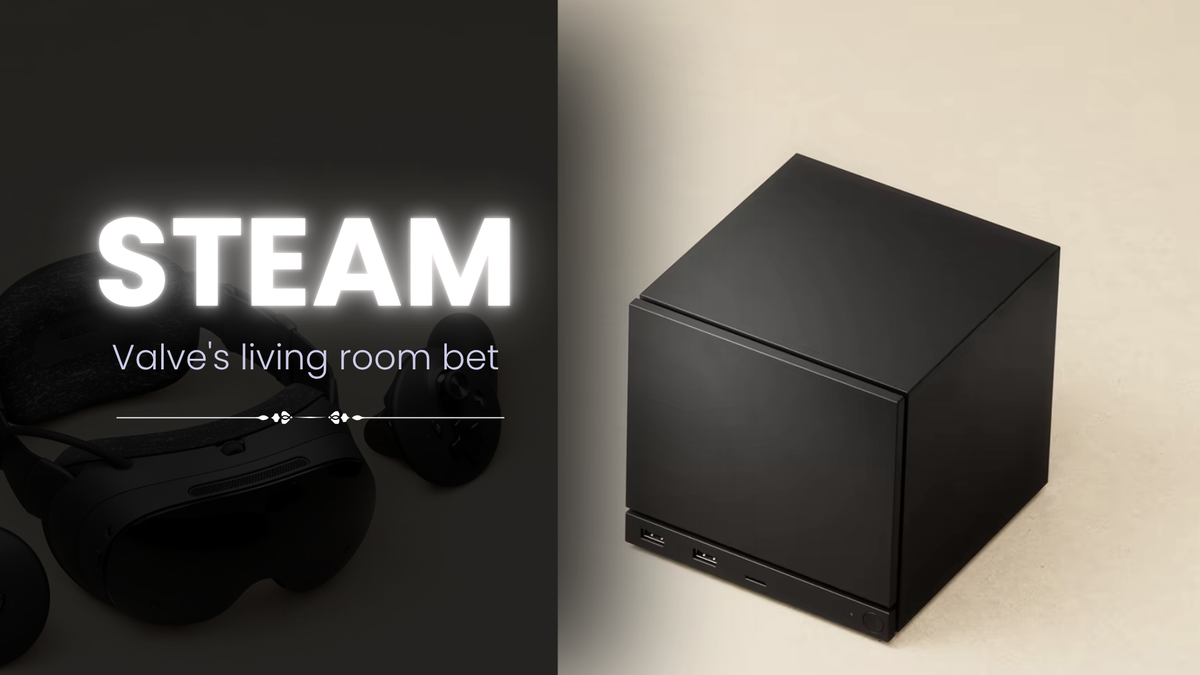
Ports: On the back you get one DisplayPort 1.4, one HDMI 2.0, two USB-A 2.0, one USB-C 3.2 Gen 2, and a gigabit Ethernet port. On the front there are two USB-A 3.2 Gen 1 ports.
One notable absence: no HDMI 2.1. Valve relies on open-source drivers and the HDMI Forum does not provide open documentation, so achieving full 4K/120Hz requires DisplayPort — provided the TV supports it.
Design
Measuring just 152mm tall, 162.4mm deep, and 156mm wide, it's a fraction of the size of even most small form factor gaming PCs. For context, it's small enough to sit on a desk next to a laptop or tuck beside a PS5 in your TV cabinet without dominating the space.
Livening up the otherwise simple black box is a lighting strip on the front edge with 17 individually addressable RGB LEDs for system status and customizability. You can also swap the front panel for other designs.
Software — SteamOS
Like the Steam Deck, the Steam Machine runs a customized version of SteamOS 3, based on Arch Linux with KDE Plasma as the desktop environment. The system boots directly into Big Picture Mode and grants access to your entire Steam library. Games without native Linux versions run via Proton.
Full desktop usage including app installation is supported, letting you configure other storefronts like the Epic Games Store and GOG, as well as install emulators and other software. Some multiplayer games with complex anti-cheat systems such as Valorant remain problematic or unplayable under Linux.
Steam Machine Verified games will be expected to support the same input methods as the Steam Deck and run at 1080p at 30fps at minimum. Unlike the Steam Deck, Valve won't require developers to support specific display resolutions or meet legibility requirements to be Steam Machine Verified, because the Steam Machine is more likely to be connected to larger displays.
Release Date
The Steam Machine is still expected in 2026, with Valve stating it is aiming for the first half of the year, but stopping short of providing a more specific release window.
Valve announced a delay citing the ongoing RAM and chip crisis as the reason, and there is always the possibility of a further delay if component pricing doesn't improve. DDR5 prices have quadrupled since Valve's original November 2025 announcement, which is putting real pressure on both the timeline and the final price.
Price — What to Expect
No official price has been confirmed. Valve has said that memory and storage shortages are affecting its pricing plans, which may be one reason the final price has not been revealed. A recent leaked $99 figure appears to refer to the new Steam Controller, not the Steam Machine.
Current expectations place pricing somewhere between premium gaming consoles like the PlayStation 5 and Xbox Series X and higher-end gaming PCs, depending on configuration and regional pricing. Given the component situation, anyone expecting a sub-$500 price tag may be disappointed.
The Steam Controller and Steam Frame
The Steam Machine isn't launching alone. Valve announced the Steam Machine alongside the second generation of the Steam Controller and Steam Frame, due for release in 2026 as part of a broader Steam hardware lineup.
The new Steam Controller works with an integrated 2.4 GHz receiver that allows pairing with up to four controllers at once without an external USB dongle. It also works with PC, Mac, and Steam Deck.
Should You Buy One
If you have a large Steam library and want to play it on your TV without building a full gaming PC — this is made for you. The combination of SteamOS, Proton, and Valve's ecosystem integration makes this a genuinely compelling option for people who are already invested in Steam.
If you rely on competitive games like Valorant or League of Legends, the Linux anti-cheat situation is still a real concern and worth researching before committing.
And if you're waiting for price clarity — that's completely reasonable. Until Valve confirms a number, budget conservatively.
CONCLUSION
Valve's Steam Machine is one of the most interesting hardware launches in gaming this year. It's not trying to be a traditional console and it's not a full gaming PC — it sits deliberately in between, betting that SteamOS and Proton have finally matured enough to carry the weight.
The specs are solid, the design is clever, and the software story is far stronger than 2015. Whether the price lands somewhere reasonable given the memory crisis will determine whether this becomes a mainstream hit or a niche product for PC enthusiasts who happen to own a TV.
We'll update this post the moment Valve confirms a release date and price. Bookmark it.