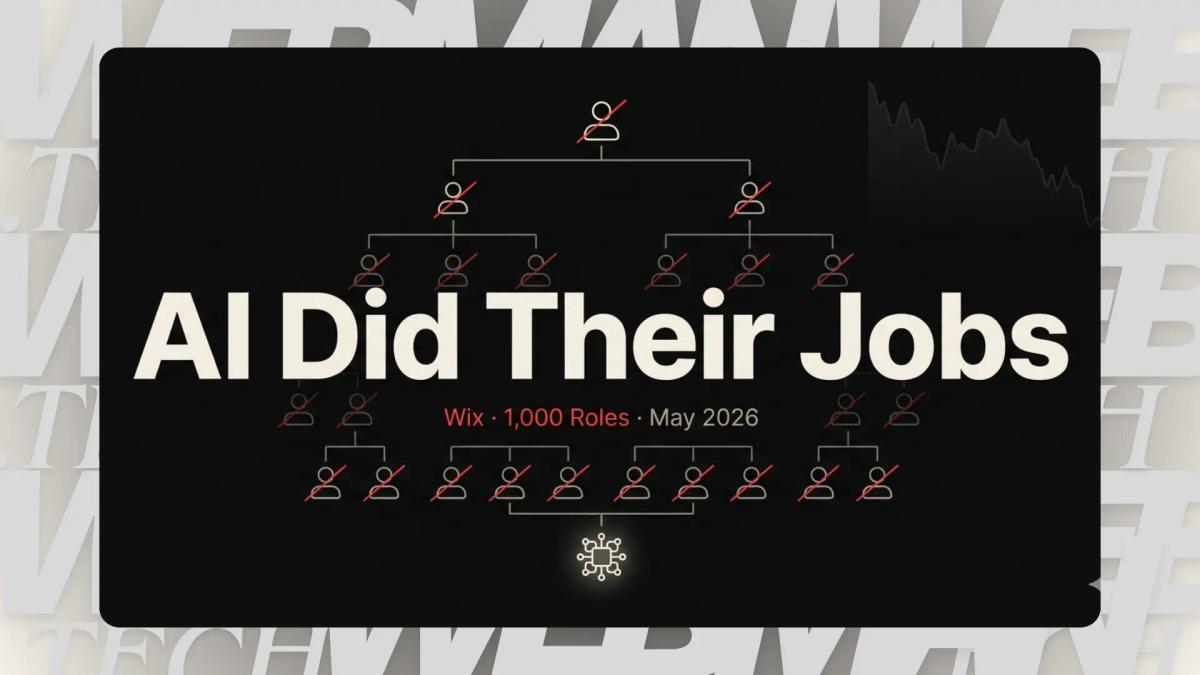
Wix Cut 1,000 Jobs. AI Did Them
May 29, 2026
Most companies laying off staff in 2026 cite "macroeconomic headwinds" or "restructuring for efficiency." Wix didn't bother with the euphemisms. On May 26, CEO Avishai Abrahami posted the announcement simultaneously on X and LinkedIn — and told employees directly: AI is doing the work that people used to do.
Around 1,000 positions are being eliminated — the largest layoff in Wix's history, cutting roughly 20% of its workforce. Revenue grew 14% last quarter. The cuts are happening anyway.
The Numbers Don't Add Up — Until They Do
Q1 2026 revenue hit $541 million, up 14% year-on-year. But Wix posted a net loss of $57.5 million. Operating expenses as a percentage of revenue surged from 21% in Q1 2025 to 35% in Q1 2026. That trajectory spooked investors badly.
On May 13, the earnings miss sent the stock down 27% in a single day. Shares have now lost more than 50% of their value since January, reducing Wix's market cap to around $2 billion — a fraction of the nearly $20 billion valuation it commanded at its 2021 peak.
Growing revenue, collapsing margins, cratering stock. The culprit isn't slow growth — it's the cost of the AI bet.
The Base44 Problem
Most of Wix's recent growth has come from Base44, the vibe-coding platform it acquired for $80 million earlier this year. Base44 lets users build software through natural-language prompts. Its annual recurring revenue hit $150 million in May 2026 — well ahead of internal targets.
That sounds like a win. It's also what's breaking the P&L.
Strong demand for Base44's tools requires enormous computing power as usage expands. And as Base44 hits revenue milestones, Wix is contractually obligated to make additional payments to founder Maor Shlomo — including $38 million in Q1 alone, with more expected later this year.
In short: Wix is spending aggressively to win the AI race while simultaneously watching its profitability disappear. The layoffs are the company's attempt to get the costs back under control.
The Two Forces Abrahami Named
The CEO cited two specific pressures driving the restructuring.
First, currency. The Israeli shekel has appreciated roughly 14% against the dollar in 2025, with a further 7% climb in the first five months of 2026 — hitting a 33-year high. Since most of Wix's revenue comes in dollars while the majority of its staff is based in Israel, this has effectively made its engineering workforce one of the most expensive in the world, occasionally outpacing Silicon Valley equivalents.
Second, AI. Wix's professional developer customers were increasingly using competing AI tools, and its own internal AI deployment was reducing the need for large specialized teams across development and design.
Both are structural, not cyclical. They don't self-correct when the market recovers.
The xEngineer: What Replaces the Roles Being Cut
Abrahami was clear that AI creates new job types even as it eliminates old ones. The company is already staffing the replacement.
Wix is collapsing its management layers to speed up decision-making and has begun hiring for a new role it calls the xEngineer — a position conceived from scratch for employees whose work is cantered on AI-native tools.
Rather than relying on large teams of specialized front-end developers and UX designers, Wix is shifting toward AI-native workflows. The xEngineer is a design-first engineer with deep domain expertise who uses AI as a core part of every workflow — handling full-stack, end-to-end development processes that previously required multiple specialists.
One person. Multiple disciplines. AI doing the connective tissue. That's the model.
This Is the Template Other Companies Are Watching
Wix is providing one of the clearest public admissions yet that internal AI deployment — not macroeconomic headwinds — is the direct driver of large-scale tech layoffs, giving other SaaS executives a reputational template and legal framing to follow.
They're not alone. Block cut nearly 4,000 jobs in February with CEO Jack Dorsey citing AI enabling "smaller, highly talented teams." Cisco cut 5% of its workforce. Meta eliminated 8,000 positions. Oracle cut up to 30,000 roles. Microsoft introduced its first voluntary retirement program. Over 134,000 tech positions have been cut across 212 layoff events in 2026 so far.
The pattern across all of them: record or near-record revenues, significant headcount reductions, and AI explicitly named as the reason.
What the Unit Economics Actually Signal
Wix is growing revenue 14% annually while actively shrinking its human organization. The Base44 acquisition running at $150 million ARR while human headcount shrinks illustrates the specific substitution path: AI-native tooling absorbs the revenue surface that formerly required engineering and design teams.
That's the signal developers should read carefully — not just at Wix, but across the industry. Revenue per engineer is going up. Headcount is going down. And the companies doing it are growing, not shrinking.
A Duke University and Federal Reserve survey of 750+ CFOs found over 80% reported zero productivity gains from AI — even as the same survey projected 502,000 AI-related job cuts for the full year. The productivity gains may not be showing up in CFO surveys. They're showing up in org charts.
Sources: The Next Web, Cryptopolitan, TechStory, AI Weekly, Yahoo Finance