SpaceX's Cursor Deal Is Official. Here's What Changes for You
June 17, 2026
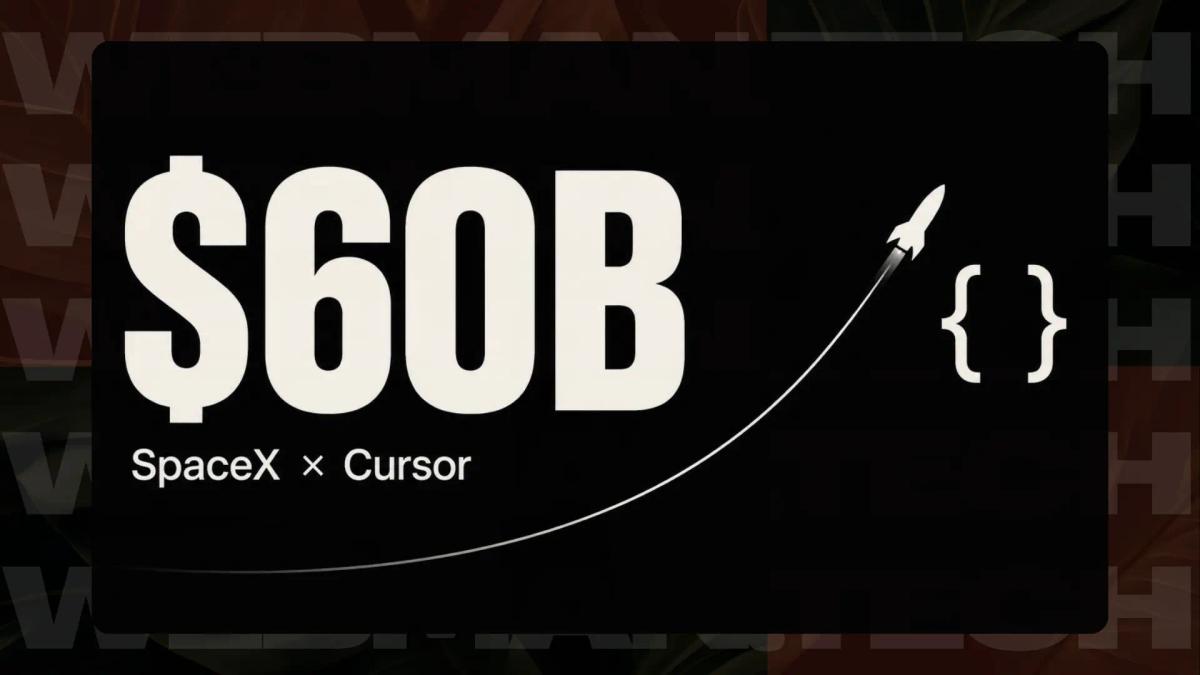
SpaceX made it official. On June 16, the company signed a definitive merger agreement to acquire Cursor — converting the option it secured back in April into a binding $60 billion all-stock deal. If you use Cursor, this is the moment to actually pay attention, not just skim the headline.
I covered the original option deal back in April. This is different. That was a maybe. This is a signed merger agreement filed with the SEC, expected to close in Q3 2026.
What Actually Changed
The deal is confirmed through an 8-K regulatory filing. SpaceX's subsidiary X67 will merge into Cursor's parent company, Anysphere, which becomes a wholly owned SpaceX subsidiary. Cursor shareholders get paid entirely in SpaceX Class A stock, with the exchange ratio based on SpaceX's average closing price over the seven trading days before close.
The timing isn't subtle. SpaceX priced its IPO at $135 a share on June 11 — the largest IPO in history at $75 billion raised. By Monday, June 15, the stock closed at $192.46. That's a market cap gain of roughly $740 billion in under four trading days — more than ten times the cost of the Cursor deal. SpaceX effectively paid for Cursor with stock gains made in a single afternoon of trading.
Before SpaceX came knocking, Cursor was on track to close a $2 billion funding round at a $50 billion valuation. SpaceX is paying $60 billion — a premium that only makes sense if you're not buying Cursor for its revenue. You're buying it for what it represents in a bigger fight.
Why xAI Needs This
This deal isn't really about SpaceX. It's about xAI's coding gap.
xAI merged into SpaceX in February 2026, bringing Grok, the X platform, and the Colossus supercompute cluster under one roof. That AI division lost $6.35 billion last year and has so far failed to build meaningful market share in AI coding tools — the exact category it's now buying its way into.
Cursor solves that problem instantly. By early June 2026, Cursor's annualized revenue had surpassed $4 billion, with about $2.6 billion of that coming from enterprise customers, and the tool is deployed inside 64% of the Fortune 500. SpaceX isn't just buying a product. It's buying distribution that would take years to build from scratch.
xAI has already been quietly co-training a model with Cursor on Colossus. SpaceX confirmed it's been jointly training a model with Cursor for months, and plans to ship it inside both Cursor and Grok Build, xAI's own coding agent, soon.
The Question Every Cursor User Should Be Asking
Here's the part that actually matters if you write code in Cursor every day.
Cursor's competitive edge has always rested on being model-agnostic — letting developers pick Claude, GPT, Gemini, or Cursor's own Composer models depending on the task. Many enterprise teams chose Cursor specifically so they could route sensitive codebases to Claude instead of trusting a single vendor.
That flexibility is exactly what's now in question. If SpaceX leans on Cursor to prioritize Grok over Claude or GPT, developers at companies with existing Anthropic or OpenAI contracts could see real workflow disruption.
One analysis put it bluntly: Cursor's real moat was model-agnostic flexibility, and if that erodes under xAI ownership, the differentiation erodes with it — developers didn't pick Cursor over Copilot for one model, they picked it so they could swap Claude in for a long refactor, use Gemini Flash for fast autocomplete, and run a local model for sensitive code.
It's a real risk, not a hypothetical one. If SpaceX eventually forces Cursor to abandon Anthropic and OpenAI models in favor of Grok, the developer experience could degrade fast, and users won't hesitate to migrate elsewhere.
What's Under the Hood: Composer 2.5
Part of why SpaceX is paying double Cursor's last private valuation is Composer, Cursor's in-house model line. Composer 2.5, released May 18, 2026, runs on a Mixture-of-Experts architecture built on the open-source Kimi K2.5 base — activating only 32 billion of its 1 trillion total parameters per token, which keeps latency low at scale.
The more interesting engineering detail is what Cursor's team calls compaction-in-the-loop reinforcement learning — training the model to compress its own working context down from thousands of tokens, which is what lets long agentic coding sessions stay coherent without ballooning cost. This is the IP SpaceX actually wants, independent of who owns the product wrapper around it.
If you're benchmarking, Composer 2 already beat Claude Opus 4.6 on Terminal-Bench 2.0 while trailing GPT-5.4 — a gap that's closed fast in this market and could close further with Colossus-scale compute behind it.
What to Actually Do Right Now
Nothing breaks today. The deal doesn't close until Q3 2026 at the earliest, and it still needs regulatory clearance — a $60 billion acquisition four months after a $1.25 trillion SpaceX-xAI merger will get real antitrust scrutiny in both the US and EU.
But it's worth doing now, not later:
Keep your model API keys independent. If you use Claude or GPT inside Cursor, keep direct API access to those models active outside the IDE. Anything wrapped by a tool can be replaced by that tool's owner — direct access can't.
Audit your data exposure. Cursor indexes your codebase to do its job. If your team handles sensitive IP, know exactly what data flows where, and revisit that once SpaceX is the counterparty instead of an independent startup.
Watch the pricing, not just the model lineup. Enterprise tools rarely get cheaper after a deal like this. Budget for it.
Don't panic-migrate. Cursor will keep working through the transition. This is a multi-quarter story, not an overnight one — there's time to watch how it plays out before making a switch.
The Bigger Picture
This is the largest acquisition of an AI developer-tools company ever recorded. It's also a signal about where the AI coding wars are actually being fought: not in better autocomplete, but in who controls the full stack — model, compute, and the product developers touch every day.
Anthropic's Claude Code and OpenAI's Codex are both growing fast on their own. Microsoft already passed on buying Cursor once, betting instead on GitHub Copilot. SpaceX just bet $60 billion that Microsoft was wrong. Whether that bet pays off depends entirely on whether Cursor stays the open, model-agnostic tool developers chose it for — or becomes another walled garden with a rocket company's name on the door.
Sources: TechCrunch, Tech Times, CNBC, Fortune, Yahoo Finance / Bloomberg
Frequently Asked Questions
Is the SpaceX Cursor acquisition final?
Not yet. SpaceX and Anysphere (Cursor's parent company) signed a definitive merger agreement on June 16, 2026, converting an earlier option into a binding deal. The transaction is expected to close in Q3 2026, pending regulatory review.
Will Cursor still support Claude and GPT models after the acquisition?
As of the announcement, Cursor's model lineup is unchanged. The concern raised by analysts is whether SpaceX will eventually push Cursor toward prioritizing its own Grok models over Anthropic's Claude or OpenAI's GPT, which would undermine the model-agnostic flexibility that drew many developers to Cursor in the first place.
How much is SpaceX paying for Cursor?
SpaceX is paying $60 billion in an all-stock deal, funded entirely through SpaceX Class A common stock rather than cash. The deal represents roughly 3.4% dilution against SpaceX's post-IPO valuation.
What is Cursor's Composer model?
Composer is Cursor's in-house coding model line. The latest version, Composer 2.5, uses a Mixture-of-Experts architecture with 1 trillion total parameters (32 billion active per token) and is trained with a technique called compaction-in-the-loop reinforcement learning to handle long agentic coding sessions efficiently.